Websites for electricians
A website that shows your registration number, explains what gets certified and lists the jobs people actually search for. From £39 a month, ordered online.
A sample design for a made-up electrician in Mold, and what each part is for
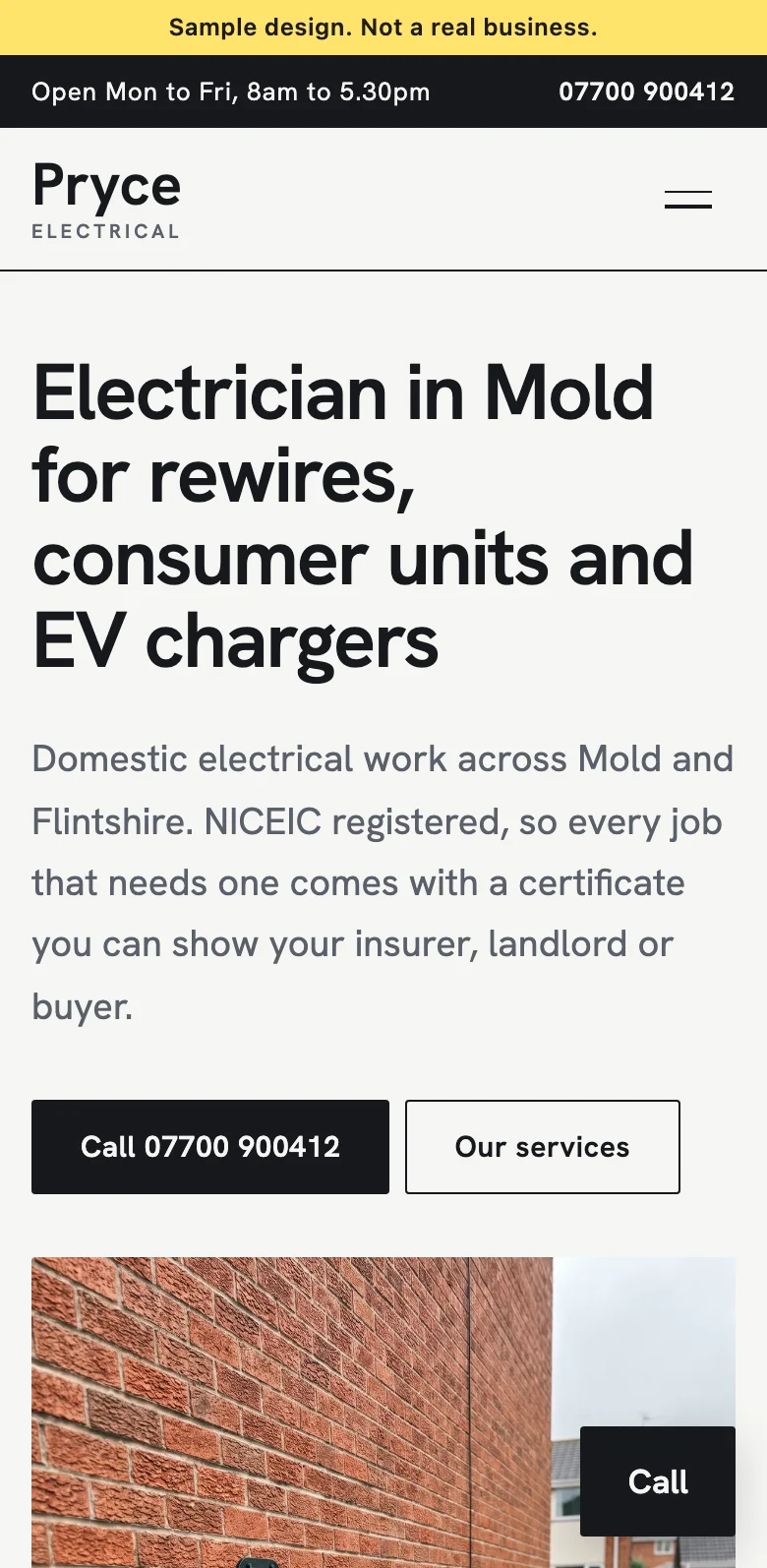
- Hours and phone number on every page. The yellow strip above only appears because this is a sample.
- The town and the jobs people search for, in the headline.
- The registration and what it means for the customer: a certificate they can show an insurer, landlord or buyer.
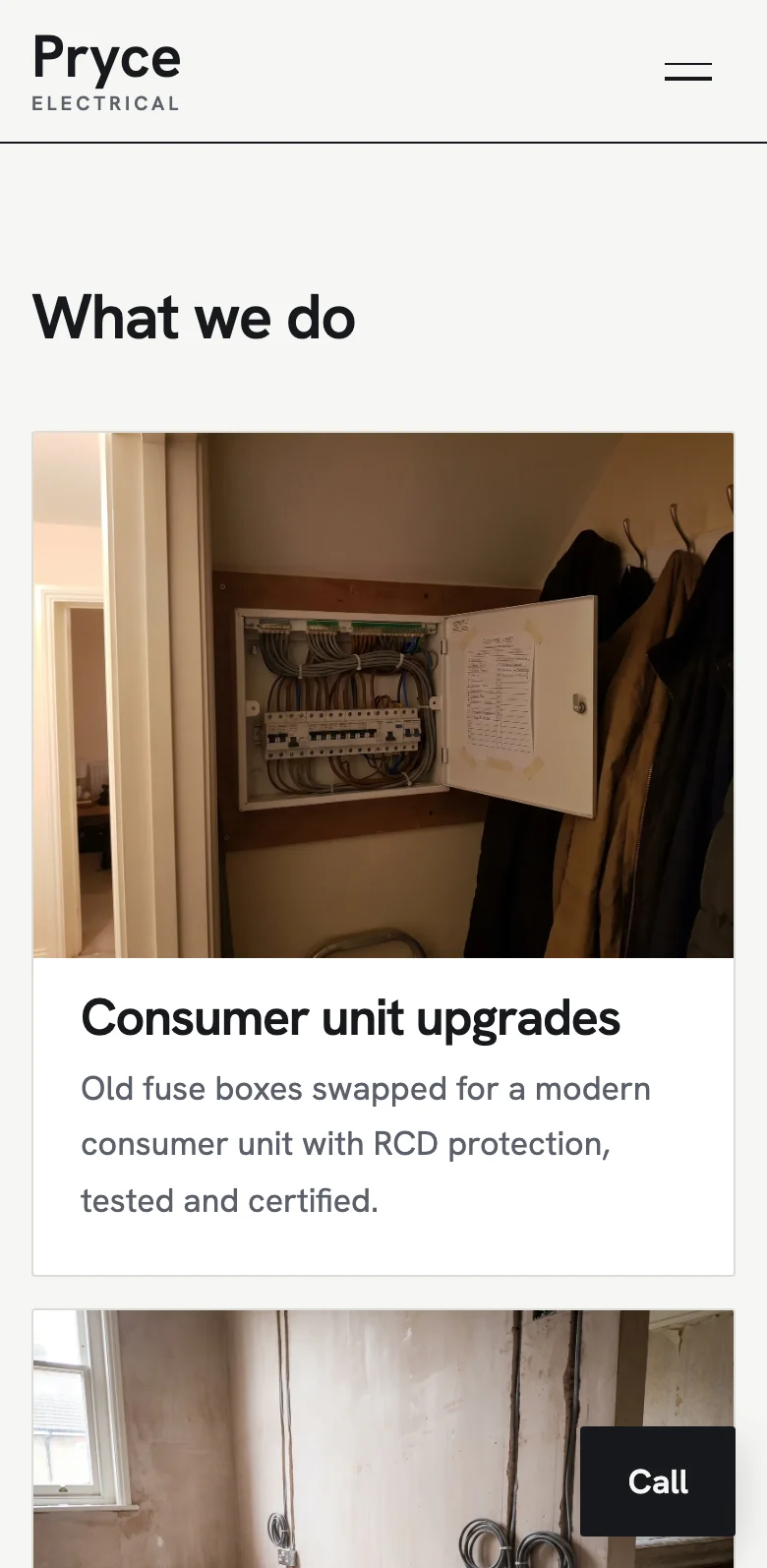
- Each main job with a photo and a plain line on what’s included.
- Every description ends with what they get: tested and certified.
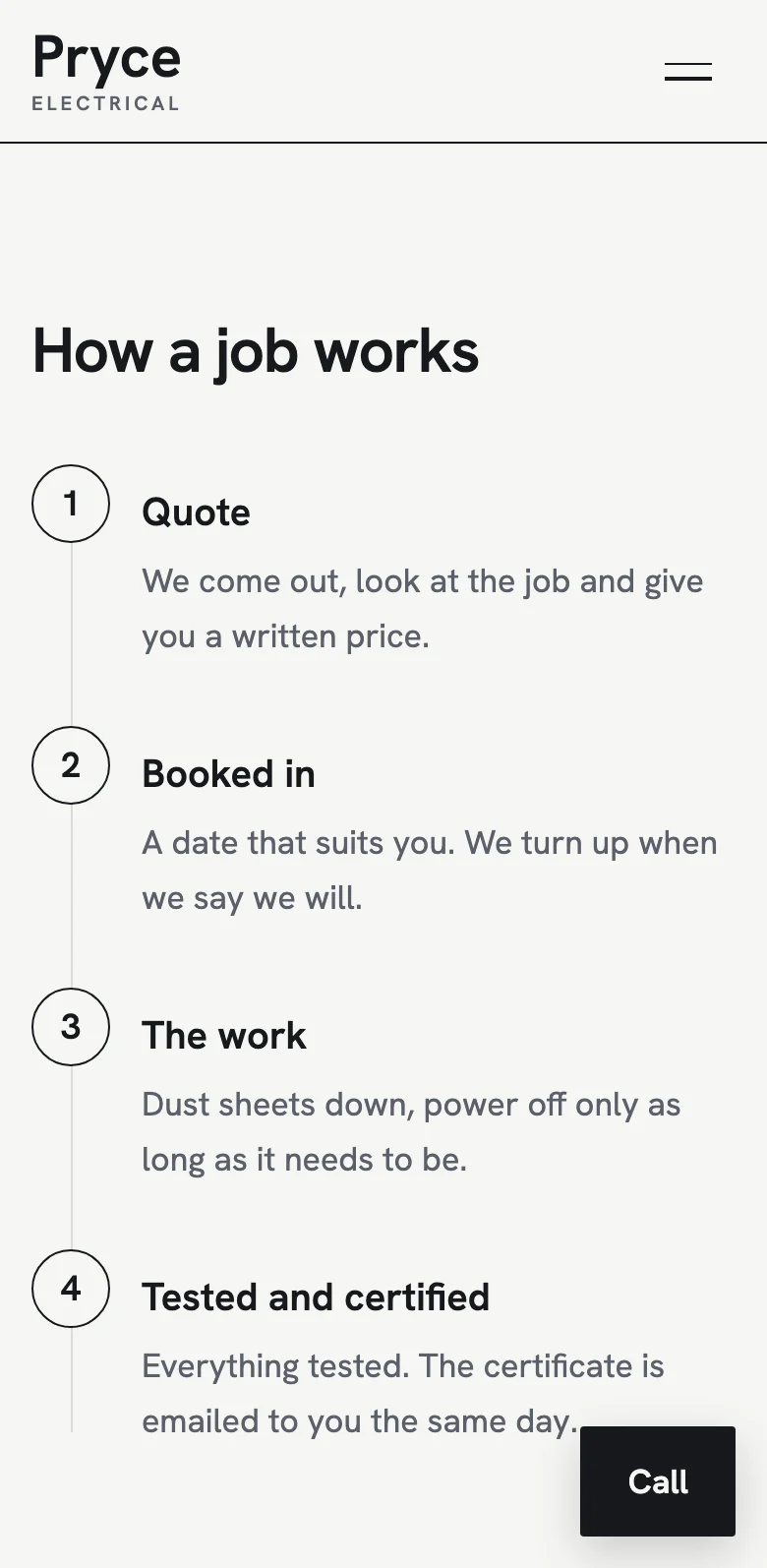
- How a job runs, so people know what happens before they book.
- The certificate is the last step, because it’s the thing they need to keep.
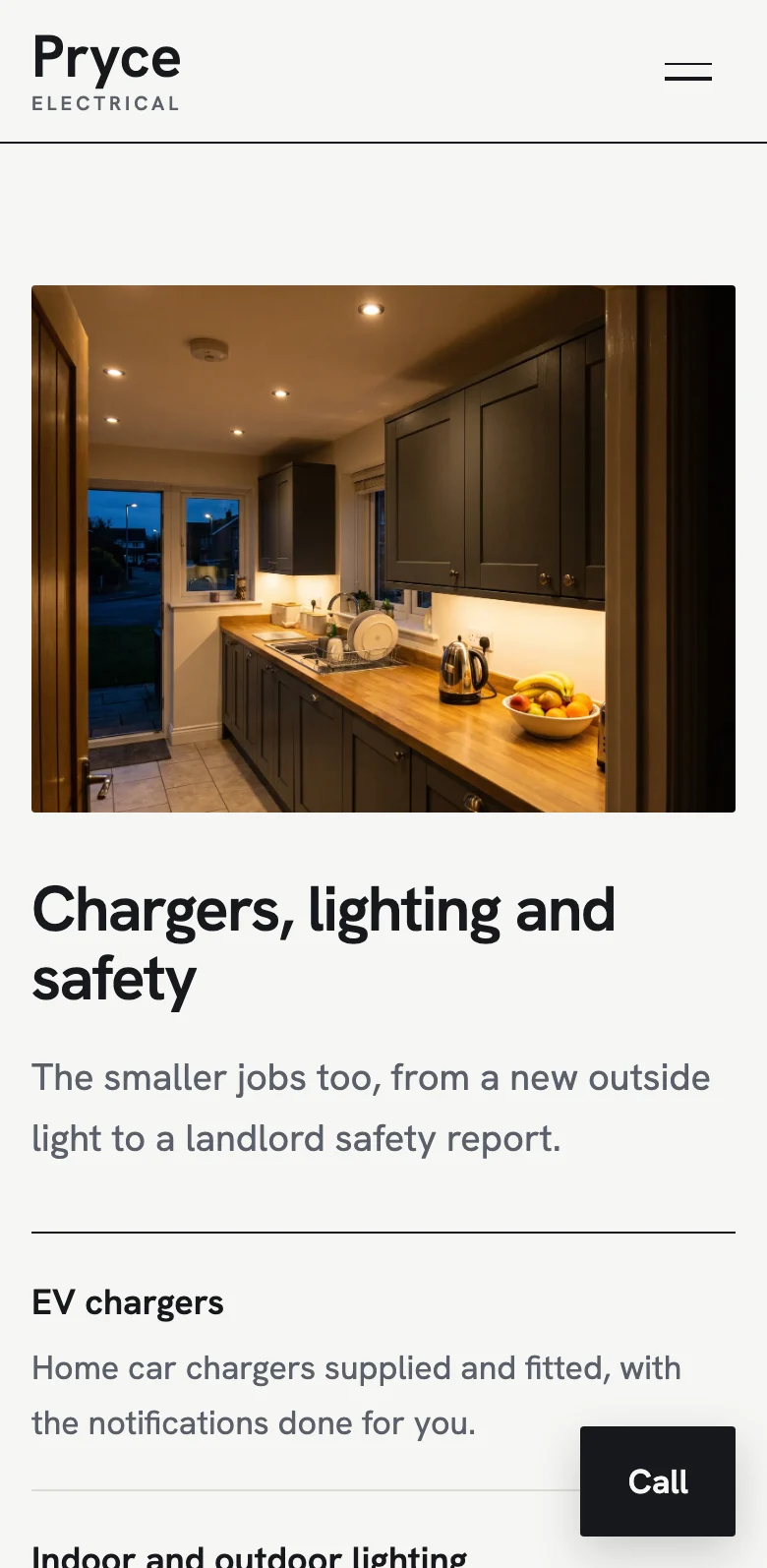
- The smaller jobs get a section too, including landlord safety reports.
- Each job written out properly, so Google knows exactly what you do.
What an electrician’s website needs
People hiring an electrician want to know you’re registered, that the job will be certified and roughly what it involves. A good site covers all three before they pick up the phone.
Your registration and number
NICEIC or NAPIT, with your registration number, not just the logo. Customers and letting agents can then look you up for themselves.
What gets certified
Say that notifiable work comes with a certificate. Homeowners need it when they sell and landlords need it for their tenants.
The jobs people search for
Consumer unit upgrades, rewires, EV chargers, EICRs and extra sockets, each written out properly. That’s how people search, so that’s how Google matches you.
Landlords as well as homeowners
If you do EICRs and landlord reports, give them their own section. Landlords need them again every few years.
Photos that show the work
A tidy consumer unit, a charger on a wall, a finished kitchen. Even simple photos show you take care.
An easy way to ask for a quote
A short form for the job and the postcode. Or a WhatsApp button so they can send you a photo of the problem.
The towns you cover
A list of towns on every plan. On Standard you also get a page for each of up to 3 towns and on Growth up to 6, which helps you show up in each one.
Registrations and schemes worth showing
In England and Wales, notifiable electrical work in a home has to meet Part P of the Building Regulations. A competent person scheme is how you self-certify it, so these registrations are what customers, landlords and solicitors look for.
NICEIC
A certification body that registers electrical contractors and assesses their work regularly. Its Platinum Promise can protect customers if the registered business that did their work has stopped trading.
NICEIC has a public search for finding registered tradespeople. We show the logo with your registration number and link to it.
NAPIT
A government-approved, UKAS accredited certification body covering electrical work as well as heating, plumbing and renewables. Like NICEIC, it lets you self-certify notifiable work.
NAPIT has a public Find a Tradesperson search. We show your badge and number and link to it.
Registered Competent Person Electrical
One register of electricians from the competent person schemes, covering England and Wales. Customers can check you there whichever scheme you're with.
Its public search works by company name or postcode, so we link to it next to your scheme badge.
MCS
The quality mark for small-scale renewables like solar panels, battery storage and heat pumps. If you fit solar or batteries, customers will look for it.
MCS has a public Find an Installer search. We show the logo on your solar or battery section.
TrustMark
The government endorsed quality scheme for work in and around the home.
TrustMark has a public Find a Tradesperson search. We show the badge if you're registered.
How people find an electrician
Searches fall into three kinds. Urgent ones, like a trip switch that won't reset or no power to half the house. Planned jobs, like a rewire, a new consumer unit or an EV charger. Paperwork, like an EICR for a sale or a rental. We write a section for each kind you want.
Landlords in Wales have their own rules on electrical safety checks for rented homes, so letting agents look for electricians who do EICRs regularly. If you want that work, we say which areas you cover and how quickly you can turn a report around.
Photos that sell electrical work
Electrical work is hard to photograph, so the tidy details carry it: a consumer unit with neat, labelled circuits, a charger mounted level with the cable clipped straight, sockets fitted square after a kitchen refit.
Check your photos for a customer's house number or car registration before you send them.
Calls, forms and photos of the problem
For faults, people ring. For planned work, many would rather send a message with a photo of their fuse board or the wall where they want a charger. A WhatsApp button lets them do that from the site, so you can price a simple job without a visit.
EV charger enquiries need a few details up front: where the car parks, how far that is from the fuse board and whether there's off-street parking. The enquiry form can ask for them.
How the costs compare
An electrician's website costs from about £150 a year on a website builder, roughly £900 to £3,300 in the first year from a freelancer, or £39 to £99 a month with a pay-monthly firm such as us. What it needs most is your registration, clear services and a landlord section if you do EICRs.
What it costs
Same price for every electrician, nothing added on later. Pick a plan to see what's in it.
Rather pay once? £695 for the website (£995 for bigger sites), then £20 a month for hosting, your domain and support.
Plus £199 setup. 12 months minimum, then cancel any time with 30 days' notice.
Order the Standard planWhat we need from you
- Your business name and the towns you cover
- Your NICEIC or NAPIT registration number
- The jobs you do (rewires, consumer units, EV chargers, EICRs)
- Photos of your work, or a link to your Facebook or Instagram
- A link to your Google or Facebook reviews, if you have them
No photos to hand? Send us your Facebook or Instagram and we'll use what's there.
Questions electricians ask
Can you show my NICEIC or NAPIT number?
Yes. We put the logo and your number on the site. Where the scheme has a public search, we link to it so customers can check you.
I’m busy enough. Why would I want a website?
Use it to pick your work. Say which jobs you want more of, like EV chargers or rewires. Then list only the areas you want to work in.
Can I add new jobs to the gallery?
Yes. Send us the photos. On Standard and Growth that comes out of your monthly changes. On Starter, a quick update like this counts as your one small change for the month. Anything bigger is £45 an hour.
Is Pryce Electrical a real business?
No. It’s a sample design we made to show what an electrician’s site could look like. The photos are generated, not real jobs.
Do you only build sites for electricians?
No. We build them for tradespeople and local businesses of all kinds. This page is about what an electrician needs.
Do I need a separate page for EV chargers?
It helps, because people search for chargers on their own. Starter and Standard have 3 to 5 pages, so a charger page fits. Extra pages are £50 each.
I only want domestic work. Can the site say that?
Yes. We write the site around the work you want and leave out what you don't, so you get fewer calls you'd turn down.
How quickly can I be live?
Usually within a week of getting everything from you. We send it to you to check before it goes live.
Ready when you are. It takes about ten minutes to order.
From £39 a month, plus £199 setup.
Order a website